Boundary Hill & Red Lakes 4 March 2026

Leader Mentor Tail Ender
Standards Selwyn Alan H Jen C
Alternates Peter Sally Moira

Statistics: Distance 11.5km/7.6km, elevation gain 519m/400m, time 4hr/ 4hr 45mi

Our group of 36 trampers (including visitor Robert and guest Eva) were all well prepared for anything, including the recent unseasonable snowfall in the mountains and the infamous matagouri we would encounter.

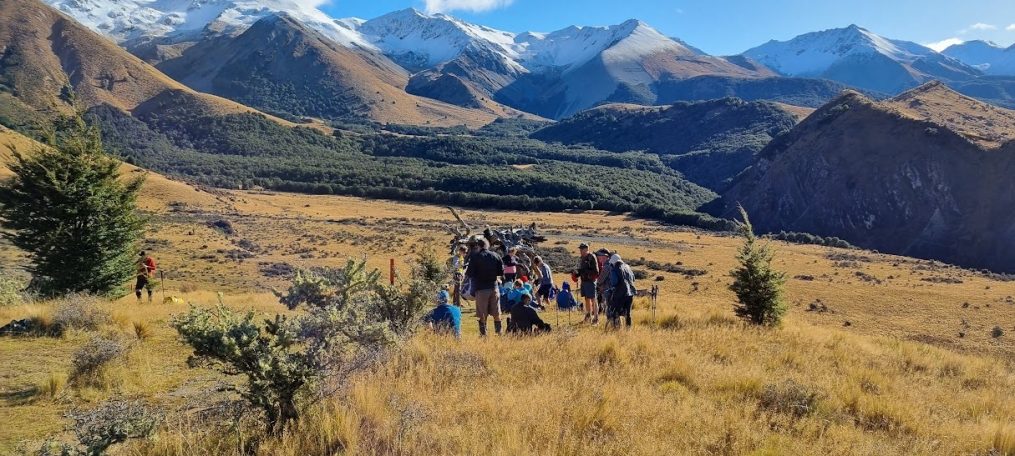
We emerged from our lovely warm bus down the Lyndon Coleridge Road to find it was actually a perfect, sunny day for our tramp. The 21 Standards soon branched off on the longer route towards Boundary Hill while the 15 Alternates took the shorter though swampier route. Neither way could be called a track; both leaders had to negotiate their way along vague paths left by meandering stock.

The Standards’ progress towards the hill was reminiscent of We’re Going on a Bear Hunt, as there were lots of swishy-swashy grass and many things to go under, along and over. These included a landslip, a fence and a rather deep ditch, not to mention a fault line. Morning tea for the Standards (except for the one who spent the time going back for his poles left at the ditch) was as usual at the rocky outcrop before our first real climb of the day.

Towards mid-day we were able to spot the Alternates high above us. There were three good reasons to look down rather than up though: the exquisite sub-alpine plants, the massive old cow-pats, and the roughness of the track those aforementioned cattle had created.  We caught up to the lunching and lounging Alternates at 12:15 and then struggled up the very steep incline to the summit of Boundary Hill (two of the Alternates had boldly opted to climb to the summit on strict instructions not to dawdle and risk holding up the return of the rest of the group back down the way the Standards had just come up.)

The best thing about getting to the top of Boundary Hill was (a) lunch and (b) the superb view of Lake Coleridge, the Rakaia River and the smattering of snow on the distant mountains. The only problem with the nice flat summit is it’s hard to find a spot for a discreet Wee Stop.

Let’s face it, the descent the Standards take from the top of Boundary Hill is always difficult. There is the dramatic drop-off to the right, very uneven ground and the nasty matagouri and spiky Spaniard to contend with. Our Leader & Mentor did a superb job guiding us despite the fact the bright orange markers from earlier years had faded into obscurity and we were a bit like Hansel and Gretel looking for breadcrumbs. Those in the front did however find a sheep cast in the matagouri, and thanks to John who rescued it.

Once we got down to the farm track below we had enough time and energy to detour to the Red Lakes (which are still a pretty green). We then marched briskly along towards the pick-up spot on the Lyndon Coleridge Road and the welcome sight of the bus with the Alternates on board arriving just minutes before we got there. Less delighted to see the bus was a huge mob of sheep milling just along the road, along with the farmer from the nearby station who was trying to move them past us. As Nicholas put it to his young German guest Eva, a quintessential New Zealand sight. Less impressive was the live stoat Lisa observed, in a very similar spot to the dead rodent Alan delighted in showing us last year.

Text by Shirls

Prebble Hill 25 February 2026

Leader Mentor Tail Ender
Standards Peter M Alan Judy R
Alternates Les G Ali Moira

Distance: Standards 12km, Alternates >8km

With Grant driving, 36 of us set out for a walk among the limestone rocks of Prebble Hill. We welcomed visitor Debbie B, Selwyn’s guest Elizabeth and the long looked-for return of Steve G. The requisite toilet stop in Springfield was done alongside a bevy of other buses, one apparently driven by our former driver Viktor. Then we were on our way to Porters Pass – random fact or pub quiz answer, take your pick –  Porters Pass is higher than Arthur’s Pass and is the third highest point on the South Island’s state highway network – points of which further north are of national significance.

Dropped off at Castle Hill Station, we were all walking (13 Alternates and 23 Standards) by 10.15am. Down the incline to a robust newish bridge which the farmer later in the day said had been put there for trampers and climbers and animals generally. Not for cars. When the weather threatens the bridge is removed by a crane. There was some conjecture from trampers about where the crane might come from. Up the other side to walk along farm tracks, beside a deer fence (containing some large healthy swedes, no deer spotted), the smell of honey signalled a cluster of beehives. Then the climb to the saddle and the top.

What a day it turned out to be. By lunchtime the sky had cleared.  Following the recent rain there was emerald green in the valleys and all around us those rocks. Sandwiches never tasted better.

After lunch, aside from the trudge up from the bridge, it’s all downhill in the best possible way.  Keeping track of her charges kept the Standards’ tailender on her toes as trampers were lost from view descending behind rocks. Rocks that look like gigantic marbles, pancake stacks or as one tramper tenderly said, the Pietà. At the bottom there’s a scramble along the side of the Porter River and some welcome river crossings to cool hot feet.

The Standards were all there at the river but in maintaining balance crossing, one tramper lost her prescription reading glasses. In their pink case they fell out of her pack. Seeing the glasses brightly bobbing away meant a loud shout went out to the tramper crossing further downstream. She scooped up the case, momentarily lost her balance and dropped it. Providing back-up was Elizabeth (subsequently revealed to be in training for a 50km trail run in Vietnam) nimbly sprinting along the riverbank.  The case was scooped up for a second time. A big thank you to Selwyn’s guest Elizabeth for the rescue.

Back at the bus the Alternates had been waiting for half an hour. They’d met the farmer and some successful trout fishers. The bus ride home was quieter, grateful.  A day to remember.

Text by Jen C

Mt Thomas 11 February 2026

Leader Mentor Tail Ender
Standards Nic W Glenys Frank
Alternates Moira Ali Kiwan

Statistics: Distance – 14.6 km/12km. Elevation gain 840m/470m. Time 5hr 45min/4hr 30min

The word Mount before Thomas may have contributed to just 21, which included repeat visitor Debbie, signing up for today’s tramp. Bus driver Phil collected Glenys and Chris W from Ohoka Rd before delivering us to our toilet stop at the Loburn Reserve. One advantage of the small number, short toilet queues when only two toilets.

The day dawned cloudy with especially gloomy skies hanging about the foothills but with the forecast promising cloud clearing in the afternoon. At 10am 14 standards, a harmonious balanced group of seven women, seven men set off on the steep Summit Track to the top of Mt Thomas, 1023m. The unrelenting steepness initially in pine forest found us enjoying an early morning tea at 10.30am to recharge our batteries. The dull weather with light drizzle and little wind provided ideal conditions for heading uphill.

We met a young woman probably 50 years younger than many, descending. With only a bottle of water to carry she had reached the summit in 1 hour 15 mins. Further on, three more fit looking women with a dog were descending after reaching the top via the Wooded Gully Track despite it being officially closed. At 12md we reached the summit where the sky cleared briefly to allow a glimpse of what the view might have revealed on a clear day. The dramatic lighting provided good photo opportunities.

We traversed the ridge on the Ridge Track squelching our way through many muddy patches before heading back in to the forest. Did I hear someone mention that the uphill was all behind us? The Ridge Track climbs steadily to cross another ridge before reaching our lunch spot at 1pm in a tussock clearing that is at the same height as the summit. The many vibrant greens of the moss covering ground and rocks together with the softer green of the lichen clinging to branches provided spectacular scenery. With much tree fall littering the forest floor there were many large trunks to climb over or limbo rock under to keep our gymnastic skills sharp. Watching your footing required full concentration on the uneven terrain.

It was when we were out of the forest and heading downhill on the final section to the bus that one uncoordinated tramper who had just been saying “my knees feel a bit weak” caught her foot under a gorse root and fell heavily banging her knee and lower leg against the inevitable rock that is always there when you fall.  Kind trampers carried her pack and gave her another walking pole to reach the bus at 4.45pm.

The seven Alternates had walked part way up the Ridge Track before retracing their steps after initially missing the turn off from the road as there is no sign. Unfortunately, they had a longish wait as they were back at the bus at 2pm in good heart with no injuries to report.  We were back at Bishopdale at 5.15pm after an enjoyable day in the serenity of the wonderful beech and podocarp forest despite the weather not really playing ball.

Text by Kate

Sign of the Bellbird/Kiwi to Evans Pass 4 February 2026

Leader Mentor Tail Ender
Standards Richard S Glenys Judy R
Alternates Ali Bev Margaret E

Distance and elevation: Standards 18km and 567m; Alternates 14km and 410m

New driver Gary greeted us in an old bus. The bus intended for us had been snaffled by an earlier driver. We all set off from Bishopdale. Jen C standing in for President Graham, did her best without a microphone to welcome returning visitor Marlene C, Lynn and Linda’s guest Debbie B and to congratulate John Hawkins on becoming a BTC member.

We were a small group of 25, with 17 Alternate walkers and 9 Standards.

The Standards were dropped off at the Sign of the Bellbird, the Alternates at the Sign of the Kiwi – not before an exchange of phone numbers and conversation with Gary about where we are to be picked up. Sighting the bus is a high point at the end of the day and we want to get this right for the club’s longest tramp.

It was a perfect day for walking on the Port Hills. Not too hot, not too cold. Just right. Bellbirds singing in the bush at the beginning, dark flax spires and swishy swashy grasses on the ridges and all around us the aquamarine sea. A Goldilocks day.

Looking back at Witch Hill, there is discussion about which way the witch is best seen. And are there three people visible at the top of the hill or is it two people and a trig station?  No way were witches involved for Māori first settlers. The hill was Te Upoko o Kūri – the shape of a dog’s head easily seen from Lyttelton Harbour. Witch Hill may have been so named by Europeans because of a tapu associated with the area. https://my.christchurchcitylibraries.com/ti-kouka-whenua/te-upoko-o-kuri/

Later, the Alternates look for signage telling the story about Linda Woods Reserve and find none. Turns out she was a keen tramper whose husband Bill Woods QSM made significant bequests to the Summit Road Society.

The Alternates at lunch are overtaken by the Standards who go on to lunch at the top of the Bridle Path. The Alternates overtake and have the lead until later in the walk when despite one of the Alternates, Gandalf-like, brandishing his walking pole and booming You shall not pass (or something similar), they too are overtaken.

On his first drive-by  Gary has not found a bus-sized parking space. Following an exchange of phone calls about arrival times at Evans Pass and while watching the Standards descending the ridge ahead, the Alternates happily see the bus curling down the road to the now waiting Standards.

Text by Jen C

Hogs Back Track 28 January 2026

Leader Mentor Tail Ender
Standards Peter Selwyn Judy S
Alternates Bev Ailsa Jan M

“Sun, glorious sun!” (which I hope you hear to the tune from Oliver of “Food, glorious food”). It really was a glorious sunny day at Bishopdale, Yaldhurst, and Castle Hill for our tramp. After the preceding weeks, 34 trampers were delighted.

Our group easily divided into 17 and 17 with our two visitors Don and John and our guest Marcial joining the Standards. (Dan and John, btw, have completed their three initial tramps, and we hope to see them as full time BTC trampers in the future.) The Standards loped off in their normal fashion, but the Alternates caught up with them at the Lightning Struck tree where morning tea was had by both groups.

The Alternates’ leader had warned them of a mountain bike race on the trail, and we before tea had stepped off the trail for four young dirty men on their bicycles. We later learned they (and others we saw later) were on the 1330 km Tour Te Waipounamu which started at Cape Farewell on Sunday before our tramp. (For more information on the “backpacking race the length of the South Island of New Zealand/Aotearoa,” go to http://tourtewaipunamu.co.nz  and bless your good sense you didn’t do it.)

The only “excitement” for the day was the somewhat daunting quite fast flowing Long River at about the 4 km mark where six Alternates exercised what they considered good sense and chose not to go further, being unable to determine how deep it was and where the holes were.  Fortunately, the remaining 11 Alternates and all the Standards made it across both ways with only one slip into the river for a Standard. And as she said, the sun was out and she quickly dried.

The Alternates lunched at the top of Picnic Lookout Hill and watched the Standards clamber up another hill in the distance. Both groups were back to the bus by 3:30 with the Standards taking the shorter route they had taken earlier in the day while the Alternates took the longer “easy” route (description on the DOC sign, not a comment by this author). The six renegade Alternates had been back since 2:20 and were comfortably enjoying the sunshine.

One other note. One tramper suggested to the author that “hogs back” was a term to describe certain cloud formations. I could not find any reference to this phenomenon, but did find numerous references to the geologic definition of a “hogback”: “a ridge of land formed by the outcropping edges of tilted strata” or “a ridge with a sharp summit and steeply sloping sides.”

Our driver Alan got us back to Bishopdale a little after 5. Again, another great day out for those who chose to come.

Text by Michele

Hoon Hay – Sign of the Bellbird 21 January 2026

Hoon Hay Reserve/Gibraltar Rock/Bellbird                                                  21 January 2026

Leader Mentor Tail Ender
Standards Warren Janice Veronica
Alternates Michele Les Kiwan

The day started off much like the previous week, checking for cancellation emails: none.

Although it was gloomy and overcast, rain was not expected until mid-afternoon, but with a local tramp in the Port Hills, trampers would likely be safely back in the bus by then and if the rain made an early arrival the bus would not be too far away.

After picking up a small group from Princess Margaret Hospital, 30 trampers, including visitors from the previous week who hadn’t been put off by wet feet, were dropped off at the Hoon Hay Reserve on the Summit Road. Donning hats, gloves and coats, the two groups, 15 in each, set off on the Crater Rim track, the Alternates’ destination a lunch spot on Coopers Knob, while the Standards would carry further on to Gibraltar Rock.

The undulating tussock track was measured not so much by up and down, but windy and not so windy. In some places on the narrow track shoulder height vegetation, including flaxes with protruding seed heads and overhanging strappy leaves, provided quite a bit of protection from the wind; as did the shelter at the Sign of the Bellbird which proved to be a popular spot for morning tea, with the Standards leaving just as the Alternates arrived.

Even though the bus was temptingly parked at the Sign of the Bellbird car park, the pickup point, and it was feeling a bit damp, possibly due to low cloud with the view over the city quickly disappearing, both groups carried on to their respective lunch stops. At one stage it seemed like the rain had arrived early when even low cloud couldn’t account for the wet droplets. Fortunately, shortly later the track carried on through an inviting grove of native bush layered with ferns. Although gnarly, with care needed on the slippery rocks, it was calm and dry, with the occasional call of a bellbird nearby.

Emerging into the open again with Coopers Knob visible in the distance, well not so visible as it was covered by low cloud, the Alternates decided to carry on and find a lunch spot in the shelter of the bush close to the rocky outcrop. The Standards had also made a similar decision, finding a lunch spot in the shelter of Omahu Bush, rather than the exposed Gibraltar Rock.

As we emerged from the bush after lunch, the weather seemed to have improved slightly and at one stage murky views of the city and Lyttelton Harbour were visible. Arriving at the junction of the bush-covered track on the right, or the track to the road on the left, it was decided to carry on the short last leg on the road, and await the Standards in the comfort of the bus.

Although not ideal tramping weather, with the likelihood of reduced activities for the next couple of days due to rain, it was good to have had the opportunity to get out in the hills.

Text by Sally

Kowai River 14 January 2026

Leader Mentor Tail Ender
Standards Jan Alan Judy
Alternates Ali Janne Moira

Our scheduled tramp to the Rakaia Gorge became a tramp up the Kowai River. This tramp was previously scheduled for last November but was cancelled due to bad weather. Rakaia was cancelled due to a major slip on the walkway. We had great weather for the tramp where our goal was the John Hayward Hut situated about 5 km from the carpark which was built in 1973 to house a long-term Lincoln University hydrology study.

We numbered 42 including four visitors and one guest. Our visitors were Diane, Marlene, Don and John. The first three learned of us from the BTC booth at the Celebrate Bishopdale event last November. John learned of us from an acquaintance on a Christchurch Council “walk and talk” who is a member of BTC. Our guest was Tianlong, a friend of Frank. We thoroughly enjoyed having all five with us and hope to see them again.

The Kowai River is located partially on the Brooksdale Station which runs from the foot of the Torlesse Range up to Porters Pass. The area includes the peak commonly referred to Bob’s Knob which some of us believe was a tramp the BTC did in the past.

But this tramp did not take us up Bob’s Knob. Rather, it started with a crossing of a fairly narrow and shallow portion of the Kowai into which at least two trampers fell after slipping on the rocky bottom – one from each group and neither was physically hurt although egos may have been.

From there, the trail was flattish leading to morning tea on the riverbed edge. After that interlude, some of the Standards continued up the riverbed while others immediately went up a short but quite steep jaunt through bush to the trail leading to the hut. The Alternates continued up the riverbed as well, necessitating two crossings of the river which was below knee high but which was moving quite swiftly. Those of us inexperienced “river crossers” appreciated those of more experience (including our visitor Don) seeing us safely across both crossings.

The Alternates arrived at the hut as the Standards were preparing to leave. Each group had the chance to inspect the hut with its four bunks and a “First Aid and Food” cabinet beside the door. After lunch, it was back to the carpark via the same path. The Alternates avoided the two river crossings by taking the shorter upper trail and descending back to the riverbed down the very steep jaunt through bush referenced above.

It was good to get back to the bus and Phillip, our driver, and to divest ourselves of our sopping boots, socks, and in some cases, the wet legs of zip off pants. Fortunately, the return trip included a stop in Darfield for the bakery or pub or ice cream. Another good day for the BTC.

Text by Michele